+91 7617005462



You have probably come across the terms “hip arthroplasty” and “hip replacement surgery” if you are looking for treatments for persistent hip discomfort. Because of this confusion, many people may question whether these are two distinct operations. Actually, one of the most effective and transformative surgical techniques in contemporary medicine is total hip arthroplasty (THA), which is commonly referred to as hip replacement.
This blog will explain the terms, go into the specifics of the procedure, and examine the many kinds, dangers, and results. This comprehensive guide will help you make well-informed decisions regarding the health of your joints, regardless of whether you are thinking about having this treatment done or are just trying to learn more about it.
What is Arthroplasty?

In medicine, the word “arthroplasty” refers to the surgical replacement or reconstruction of a joint. It can apply to any joint replacement, including the knee, shoulder, or hip. Consequently, one type of hip joint operation is hip arthroplasty.
Although the most well-known type of hip arthroplasty is complete hip replacement, the term also refers to partial hip replacement and hip resurfacing. However, for the majority of patients and situations, hip replacement and hip arthroplasty mean the same thing: the total replacement of the hip joint.
A Closer Look at Total Hip Replacement (Total Hip Arthroplasty)

The goal of total hip replacement surgery is to repair and relieve pain in a hip joint that has been injured or destroyed by arthritis. A prosthesis, or artificial joint, is used to replace the damaged parts of your hip joint that were removed during the procedure.
A ball-and-socket joint makes up the hip. The “socket” is the acetabulum, a component of the pelvis, and the “ball” is the head of the femur (thighbone).Cartilage cushions the bones in a healthy hip, enabling smooth motion. When this cartilage deteriorates, the bones grind against one another, resulting in severe stiffness and pain.
The steps involved in a hip replacement procedure are:
- A metal stem is inserted into the femur’s hollow centre to replace the injured femoral head. A ceramic or metal ball is then positioned on the stem’s upper portion.
- replacing the acetabulum’s injured cartilage surface with a metal socket. The new ball and socket are separated by a metal, ceramic, or plastic spacer to provide a smooth gliding surface.
Read more: Difference Between Heart Bypass and Open Heart Surgery: Everything You Need to Know
For whom is hip replacement surgery appropriate?
The most prevalent cause of hip replacements is arthritis, although other illnesses can also seriously harm the hip joint.
Hip replacements are often performed for the following reasons:
- Osteoarthritis: It harms the slippery cartilage that covers the ends of bones and is frequently referred to as “wear-and-tear” arthritis.
- Rheumatoid Arthritis: An illness causes inflammation that breaks down bone and cartilage as the body’s immune system targets the joint lining.
- Osteonecrosis: It happens when the bone collapses and deforms due to insufficient blood flow to the ball area of the hip joint.
- Post-traumatic Arthritis: It may occur after a severe hip fracture or injury.
If your hip discomfort remains after taking medicine, gets worse when you walk, interferes with your sleep, or makes it hard to accomplish daily tasks like getting out of a chair or ascending stairs, your doctor may suggest a hip replacement.
Hip Replacement Key Trends and Innovations
The field of orthopedics is continuously advancing. Key trends are focused on improving precision, accelerating recovery, and enhancing implant longevity.

- Robotic-Assisted and AI-Powered Surgery: Surgeons are using innovations such as the ORTOMA AI platform to help them achieve greater precision when performing total hip replacements. Robotic arms aid in implant placement and bone preparation, resulting in improved functionality and longer-lasting outcomes.
- 3D-Printed Custom Implants: 3D printing makes it possible to create precisely tailored implants for patients with unique anatomy or substantial bone loss.
- Shift to Younger Patients: In order to preserve their quality of life, more and more youthful, active patients are choosing hip replacement surgery as implants become more robust and surgical methods less invasive.
Surgical Methods: How Hip Replacements Are Performed by Surgeons
A total hip replacement can be performed using a variety of surgical techniques. The decision is frequently influenced by the patient’s anatomy, the type of implant being utilized, and the surgeon’s preference.
Posterior Approach: This is the method that is most frequently used globally. The rear of the hip is cut by the surgeon. It gives the surgeon a great view of the joint.
Direct Anterior Approach (DAA): DAA method, which includes making an incision at the front of the hip, is becoming more and more popular. Because it doesn’t damage important muscles, experts say it could result in a quicker initial recovery and a decreased likelihood of dislocation.
- Direct Lateral Approach: This technique, which involves making an incision on the side of the hip, has the lowest risks of dislocation but also entails the risk of a post-operative limp.
The key to a successful outcome is ultimately the surgeon’s knowledge and familiarity with a specific technique.
Understanding Implant Types and Fixation Methods
Although there are several varieties and fastening techniques for hip implants, modern hip implants are quite durable. Cemented, uncemented implants are the two main methods of bone attachment. A number of variables, including the patient’s age and bone health, influence the decision.
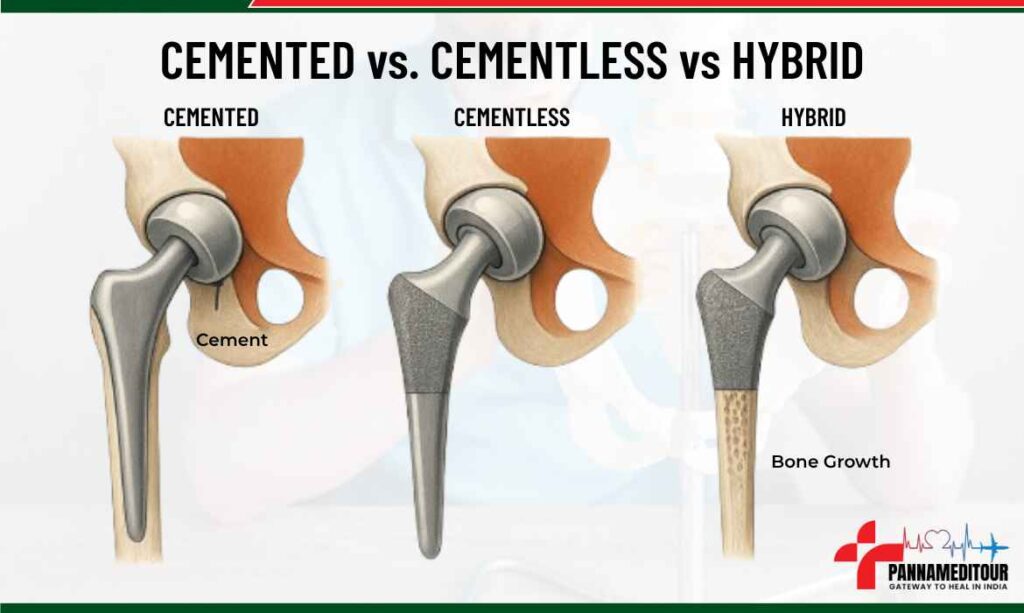
| Implant Fixation Type | Percentage | Description |
|---|---|---|
| Hybrid | 45.1% | An uncemented socket and a cemented femoral stem. |
| Uncemented (Cementless) | 40.2% | Depends on the bone developing onto the implant surface and a press-fit. |
| Cemented | 13.5% | Secures both parts with bone cement. |
| Reverse Hybrid | 1.1% | A cemented socket with an uncemented stem. |
Risks and Reasons for Revision Surgery
Even though hip replacement surgery is quite safe, there are still hazards associated with it, such as blood clots, infections, fractures, dislocations, and nerve damage. Additionally, implants may loosen or wear out over time, requiring a revision, or a second surgery.
The most frequent cause of revision surgery is aseptic (non-infection-related) loosening. This occurs when the implant’s link with the bone deteriorates over time.
| Top Reasons for Hip Revision Surgery | Percentage |
|---|---|
| Aseptic Loosening | 24.7% |
| Dislocation / Sublation | 17.4% |
| Periprosthetic UX Fracture (Fracture around the implant) | 16.4% |
| Infection | 15.5% |
| Adverse Reaction to Debris | 14.3% |
Life After Hip Replacement: Recovery and Expectations
Most patients are doing well three months following hip replacement surgery, and benefits can last for up to a year. However, recovery times vary. A vital component of the healing process, physical therapy aids in the restoration of your strength and range of motion.
You can resume most activities with your replacement hip, but it’s not invincible. Generally speaking, high-impact sports like basketball and jogging are avoided. Most patients, however, are able to enjoy lower-impact sports like swimming, golfing, cycling, and hiking without having to deal with the persistent pain they had before surgery.
For further reading: COPD Stages and Treatment: GOLD Criteria, Symptoms, and Best Care Options
Conclusion: A Step Towards a Pain-Free Life
When discussing a highly successful treatment that replaces a broken hip joint to relieve pain and restore mobility, the words hip arthroplasty and hip replacement are almost identical. The first step in determining whether a hip replacement is the best course of action for you is speaking with an orthopedic surgeon if your hip discomfort is interfering with your everyday activities.
Get a Personalized Assessment from Our Orthopedist! Contact Us
Frequently Asked Questions
1. How long does it take to recover from a hip replacement?
Though complete recovery may take a year or longer, patients recovering from hip replacements can anticipate returning to the majority of their normal activities in 6–3 months.
2. What is the average age for hip replacement?
Although there is no set age limit, people of various ages, from teenagers to those in their 90s, get hip replacements. The average age for one is said to be between 60 and 70 years old
3. What is total hip arthroplasty surgery?
Total hip replacement (THR) or total hip arthroplasty (THA) is a surgical technique in which artificial parts, or prostheses, are used to replace a diseased or damaged hip joint.
4. What is the 90% rule with hip replacement?
Patients are specifically cautioned about bending their hip joint past a 90-degree angle.
5. Who is a good candidate for THA?
- Rheumatoid arthritis, osteoarthritis, or other inflammatory arthritis types.
- A disorder known as avascular necrosis of the femoral head occurs when the femoral head starts to degrade due to insufficient blood flow.
- complicated hip injuries or fractures.